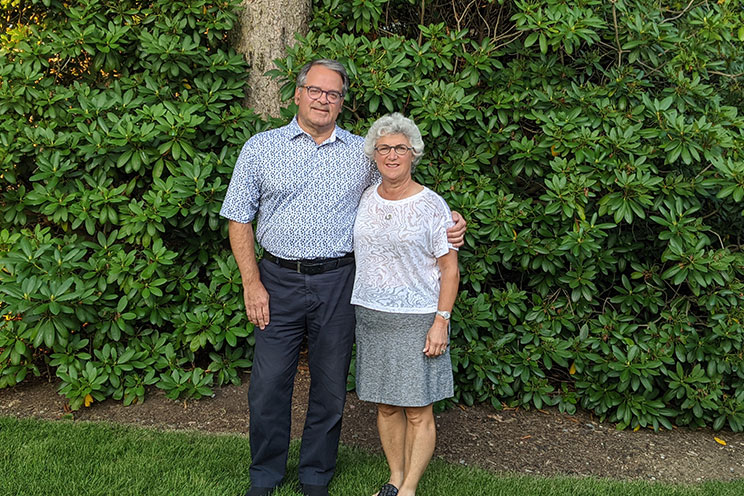
For nearly a decade, Dr. Howard Conter and Karen Conter have been among the most passionate champions behind BMO Ride for Cancer. Longtime riders, generous donors and dedicated fundraisers, they understand that every dollar raised represents something far greater than technology alone — it represents more time.
They ride in memory of both of their fathers, who died from pancreatic cancer. They ride for close friends currently facing the disease. And they ride because they believe everyone deserves access to the best possible care, close to home.
That belief has inspired Howard and Karen to challenge others in their lives to join them in investing in the future of cancer care. Their message comes at a pivotal moment, as the BMO Ride for Cancer community works to raise $600,000 by June 30 to accelerate the funding of minimal residual disease (MRD) monitoring technology — a breakthrough that can detect signs of cancer returning earlier, enabling more personalized treatment and, in some cases, better outcomes for patients across Atlantic Canada.
As a family physician, Howard has also witnessed first hand how donor-funded innovations made possible through BMO Ride are transforming care for his own patients. Together, he and Karen share why they ride, why they give and why they believe now is the time for others to step forward.
Q: You’ve both been involved with BMO Ride for Cancer for many years. What’s your ‘why’ and who do you ride for?
Karen:
“How can we not participate? This is our community, and if we have the means to help people get healthy and stay healthy — or, when they’re sick, access the best care and treatments — it only creates a healthier future.
For our kids, our families and our friends, we all need to chip in. Whether it’s volunteering, going for a bike ride, giving dollars or simply showing up, it doesn’t matter how it comes. If you have the means or the ability to help in some way, I think it’s important that we support our community and our health care.”
Howard:
“The fact is that if we can slow down cancer, cure cancer or decrease the amount of disease load there is, then what we’re really doing is buying years. We’re buying time, which means you’re buying more graduations, more weddings, more Christmases, more time with your children and grandchildren. It’s priceless.
As for who we’re riding for, both Karen and I ride for our fathers. Both had pancreatic cancer and passed away from the disease. As for giving, luckily, at this point we have the ability. We can. ‘If you can, you should,’ as I tell all the other folks that I ask for money from.”
Karen:
“We’re also riding for friends. We have some very close friends who are having some huge struggles, and our hearts go out to them and their families. If donating and raising funds can do something to help people in the future and help them today…how can you say ‘no’?”
Q: Why are you encouraging others to join you in investing? What would you say to those who have yet to donate to a rider in their life?
Howard:
“Cancer is the most common disease affecting families. It touches almost every family in Nova Scotia. The cool thing is that we’re really at the precipice of being able to improve and access technology that actually allows us to start beating cancer.
This project we’re funding now — minimal residual disease monitoring technology — is unlocking the ability to look for residual cancer cells in the body after treatment and get to them before they become metastatic or spread.
I think people need a little encouragement to realize they can give and that they can make a significant difference with their investment. We’re not talking about funding bricks and mortar here. We’re funding treatments and technologies that will improve our ability to detect and treat cancer faster and more effectively. It’s a no-brainer”
Karen:
“Maybe you were brought up in a family where you watched your parents or grandparents donate or contribute their time to organizations. Those traditions and examples that we set have a ripple effect. It’s so important that if you’re in a position to give — whatever that may look like — that you do.”
Q: Howard, as a family physician, has there been a particular moment for you through BMO Ride for Cancer that’s felt full circle? What’s the impact you’re seeing?
Howard:
“There’s been many full-circle moments. In particular, when Donnie Clow and I were fundraising for the QEII’s first da Vinci robot through the QEII Foundation and BMO Ride for Cancer. I’ve now had several patients receive robotic surgery at the QEII for kidney and prostate cancer.
That robotics technology has been tremendous, but without the fundraising, patients wouldn’t have access to it. Everything from radiotherapy technology, like Ethos and CT simulation, to the Cancer Prep Lab, where they’re now doubling the number of chemotherapy doses that can be prepared each day. These have been funded by our riders and donors — and they’re impacting the patients that I and others see in a big way.
These projects are reducing the number of treatments required, introducing more targeted and effective therapies, ensuring less collateral damage, less infection, better outcomes and quicker wait times…the list just goes on.”
Karen:
“And it doesn’t just benefit the patient going through it. If a loved one is able to heal and recuperate that much quicker, it has a significant impact on their whole family. It helps everyone.”
With the BMO Ride for Cancer community rallying around the next breakthrough in cancer care, Howard and Karen are excited for what comes next — and proud to be part of a movement that’s changing lives close to home. To donate to their team, Team Robotics, click here.
BMO Ride for Cancer is proudly hosted by the QEII Foundation.


